

In This Guide
- The answer: use the lightest structure that survives the full lifecycle
- Run the decision sequence before signing
- Personal ownership is the baseline, not the fallback
- A company changes the taxpayer and the exit
- A trust is a governance tool before it is a tax tool
- Price the structure through rent, succession and sale
- Frequently Asked Questions
- Sources Used in This Guide
- Related Articles
The practical default for buying property abroad is direct personal ownership. Move to a company only when liability separation, several investors, reinvestment, local rules or a planned share exit justify a second taxpayer and recurring administration. Use a trust or foundation-like vehicle when governance, incapacity and succession objectives justify giving legal control to trustees or a governing body. Tax may improve, worsen or merely move to another person under either structure.
Make that choice before the reservation agreement. A later transfer from yourself to a company or trustee can be treated as a disposal at market value, trigger transfer charges, require lender consent and restart holding periods. The Australian Taxation Office's guidance on related-party property transfers is a clean example: even a gift can be tested at market value for capital gains purposes.
Decision rule: compare the same property, financing and exit under each structure. Count tax in the property country, tax where the owner or beneficiaries live, annual compliance, succession mechanics and the cost of getting money out.
The answer: use the lightest structure that survives the full lifecycle
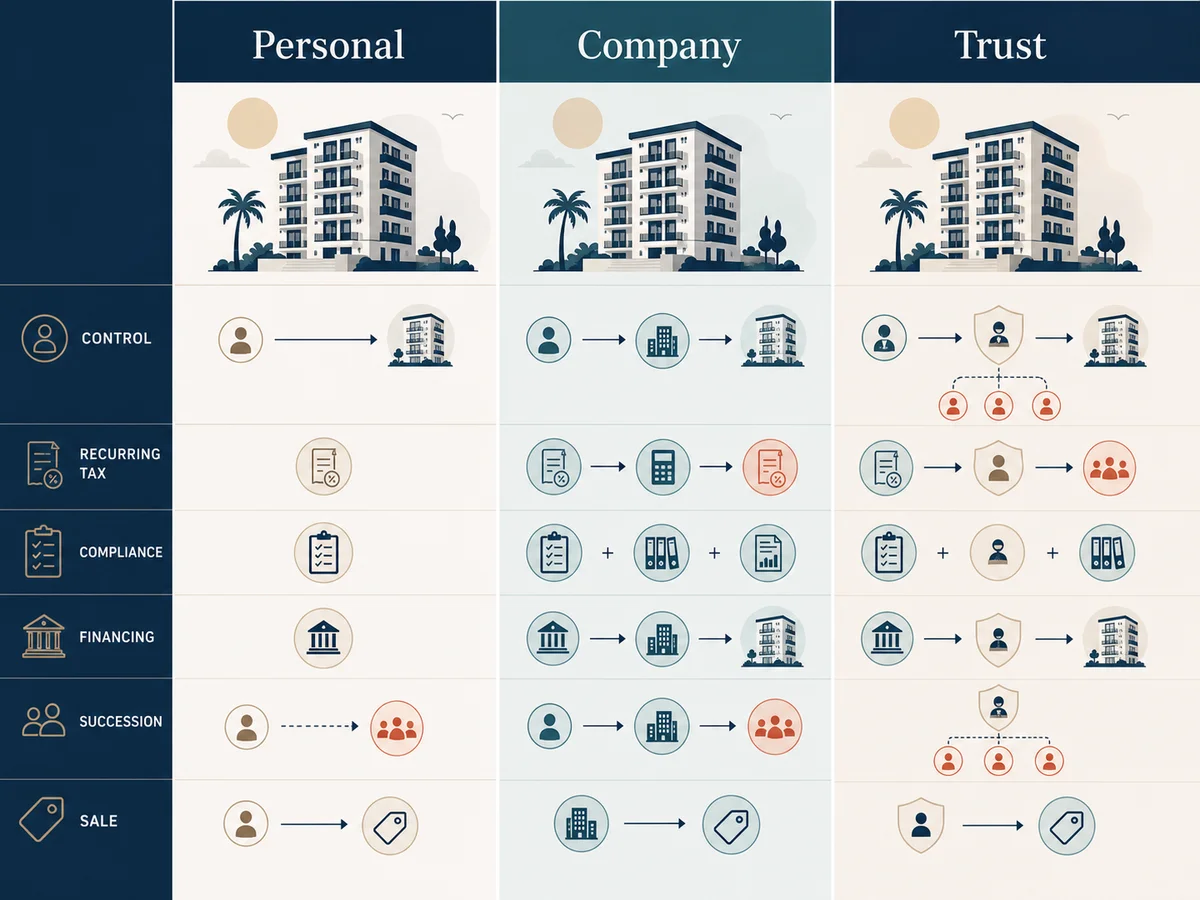
| Structure | Often fits | Main cost or risk | Question that decides it |
|---|---|---|---|
| Personal ownership | A home, occasional-use property or one investor with straightforward financing | Personal exposure to property liabilities and direct succession administration | Can insurance, a will and co-ownership terms solve the non-tax issues? |
| Company | Commercial letting, development, joint investors, retained profits or a genuine business platform | Accounts, filings, beneficial-owner reporting and possible tax when profit is distributed | Does the commercial benefit exceed the second layer of cost? |
| Trust or foundation-like vehicle | Family governance, minors, incapacity planning, multi-generation control or ring-fenced stewardship | Loss of direct control, trustee or council fees, special tax rules and reporting | Is there a documented governance goal that direct ownership cannot meet? |
Use the table to screen options. A country may charge companies a special acquisition rate, deny a personal capital-gains relief, or impose an annual charge on company-held homes. The UK, for example, has separate Stamp Duty Land Tax rules for corporate bodies and an Annual Tax on Enveloped Dwellings regime for certain residential property held by non-natural persons. Reliefs exist, but relief can require a return.
Australia illustrates another structural difference. Eligible individuals and trusts may access a capital-gains discount, while companies generally cannot use that discount. This is why a corporate tax rate, viewed alone, tells you very little about the after-tax sale proceeds.
Run the decision sequence before signing
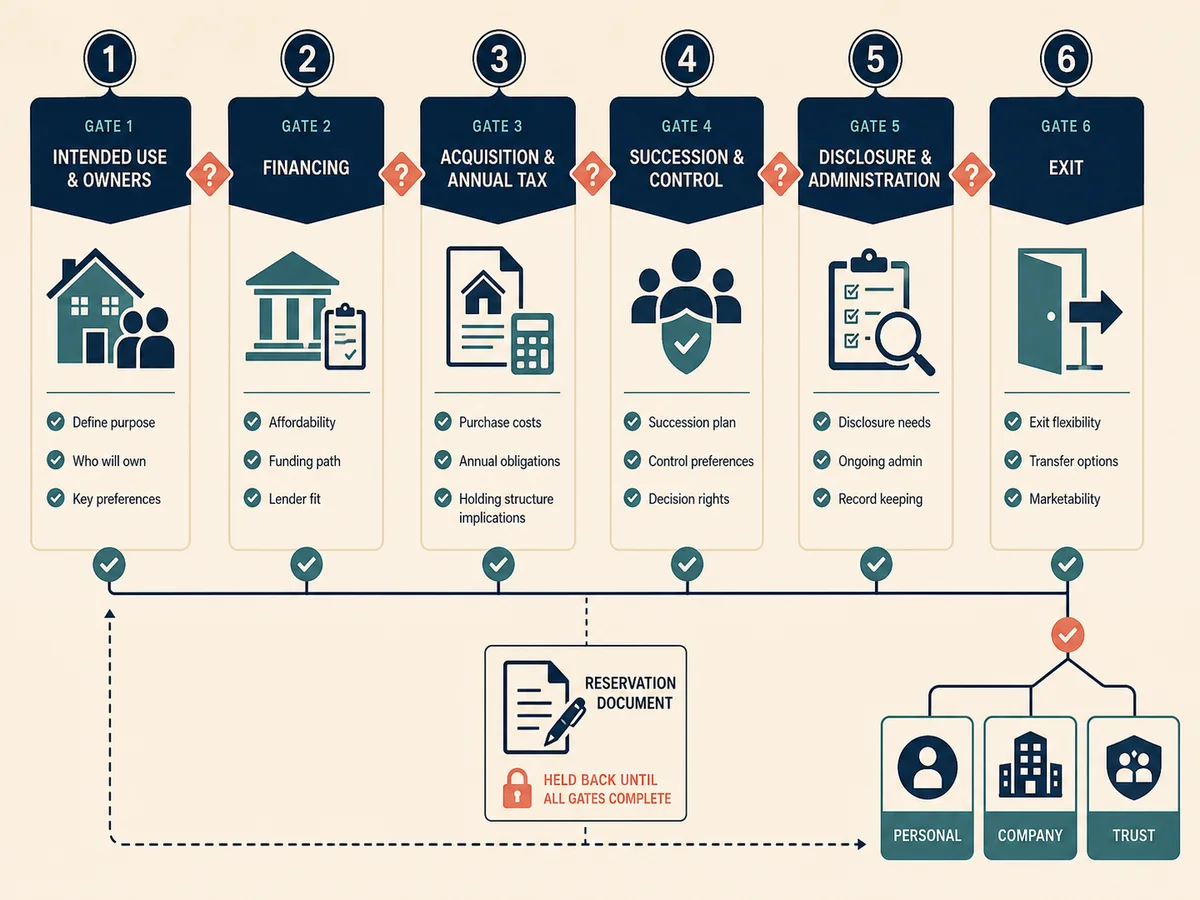
Start with intended use and work outward. Owner-occupied homes, long-term rentals, short stays and development projects can fall under different lending, licensing and tax rules. Then obtain written quotes for the same buyer profile. A cheap company loan that does not exist is not an option, and a trust that the bank will accept only with personal guarantees may provide less separation than expected.
| Order | Decision | Evidence to obtain before purchase | Failure to catch |
|---|---|---|---|
| 1 | Use and owners | Personal use, rental plan, investor percentages and local ownership restrictions | Using a business vehicle for a mainly private home without pricing benefits or special charges |
| 2 | Financing | Term sheets for each legal owner, guarantee terms and permitted title holder | Forming a vehicle that the preferred lender will not finance |
| 3 | Acquisition and annual tax | Transfer duty, VAT or GST, land tax, rental tax and available deductions | Comparing income-tax rates while ignoring purchase and annual property charges |
| 4 | Succession and control | Local succession opinion, will coordination, trust deed or foundation charter | Assuming company shares or a trust override forced-heirship and tax rules everywhere |
| 5 | Disclosure and administration | Land, company, trust, tax and beneficial-owner filings with annual cost | Treating an entity as a privacy device rather than a reportable structure |
| 6 | Exit | Asset-sale, share-sale, distribution and restructuring calculations | Optimizing rent while making the eventual sale more expensive |
Run the analysis in at least two countries: where the property sits and where the individual, company, trustees, founder or beneficiaries are tax resident. Add a third country when an entity is incorporated elsewhere. Treaties can allocate taxing rights and offer double-tax relief, but they do not turn property income into stateless income. Our practical guide to double tax treaties explains that second-stage relief calculation.
Personal ownership is the baseline, not the fallback
Direct ownership keeps title, borrowing and cash flow in one name. There is no company balance sheet or trust deed between the buyer and the property. For a single family home, that simplicity often makes lender underwriting, insurance, expense records and a later sale easier.
Tax still crosses borders. The property country commonly taxes rent and gains because the asset is there; the residence country may also include the income and grant a credit or exemption. Canada, for example, applies withholding and filing rules to non-resident rental income, described in the CRA's non-resident income tax guide. Country-specific rental and gains rules belong in a separate calculation; the site's non-resident property-tax guide covers that broader layer.
Succession deserves equal weight. Direct title can require a local grant, translation, tax clearance or coordination between wills. Co-ownership form can change the result. UK guidance distinguishes joint ownership that passes automatically from ownership in defined shares that can pass under a will. That joint-tenant versus tenant-in-common distinction is jurisdiction-specific, but the planning question applies widely.
Direct ownership becomes less attractive when several unrelated investors need voting rules, when a development business carries contractual risk, or when profits will be retained for more purchases. Do not use an entity to solve a risk that good insurance and a co-ownership agreement already solve more cheaply.
A company changes the taxpayer and the exit
A company can separate legal title and operating liabilities from its shareholders. It can also make investor entry, governance and retained reinvestment more orderly. Those are commercial benefits. They do not prove tax savings.
The company reports rent, claims permitted costs and pays tax under the rules that apply to it. Cash then reaches the owner as salary, dividend, loan repayment or liquidation proceeds, each with separate treatment. The owner's residence country may apply controlled foreign company, benefit-in-kind or shareholder-loan rules. A foreign company can also be tax resident where it is actually managed, regardless of the registered office.
Test anti-avoidance and substance against the exact relief being claimed. Do not assume incorporation, a registered address or outsourced administration proves commercial substance. Record who approves financing, signs contracts, controls bank accounts and makes sale decisions. The required people, premises and expenditure vary by rule, so there is no universal property-company safe harbor.
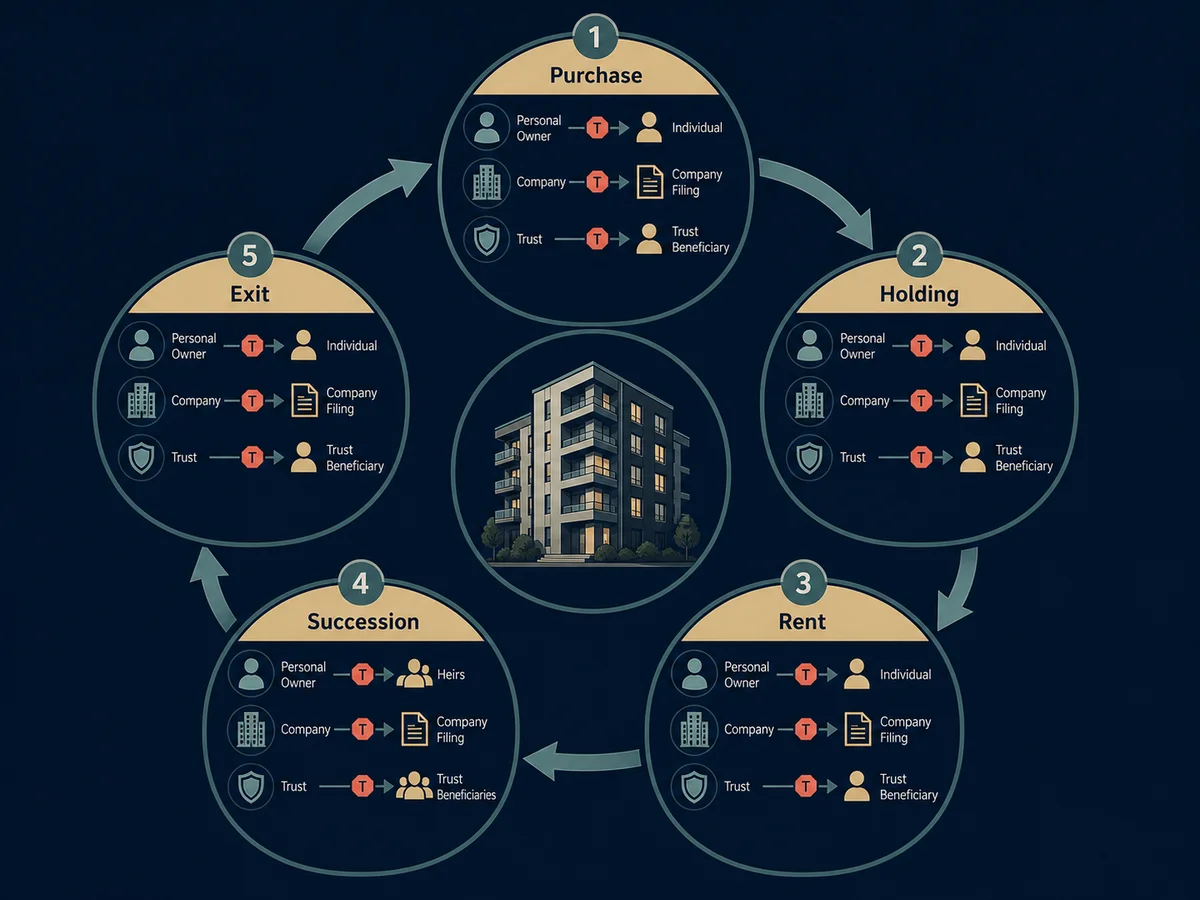
| Lifecycle point | Personal owner | Company owner | Trust or foundation-like owner |
|---|---|---|---|
| Purchase | Individual buyer tests and personal surcharges | Corporate or non-natural-person rates and reliefs may apply | Trustee or vehicle classification and deed terms can affect treatment |
| Annual rent | Reported by the individual under source and residence rules | Reported by the company; distributions create a second calculation | Tax may fall on trustees, the vehicle, beneficiaries or a combination |
| Personal use | Usually the clearest legal use | Can create benefit, distribution or deductibility issues | Must be permitted by governing documents and tax rules |
| Death or incapacity | Title and succession process apply directly | Property stays in the company; shares and director control still need succession planning | Continuity can improve, but trust, foundation and inheritance taxes still require testing |
| Sale | Owner sells the property | Company sells the property or shareholders sell shares | Trustee or governing body sells; distributions need a separate analysis |
A share sale is not a universal escape hatch. Property countries may tax indirect disposals of property-rich entities. The UK's non-resident indirect-disposal guidance and the US FIRPTA withholding rules show two ways that entity interests can remain connected to local real estate. Buyers may also prefer an asset deal to avoid inheriting company liabilities.
A trust is a governance tool before it is a tax tool
A trust splits legal ownership from beneficial enjoyment. A foundation-like vehicle usually has legal personality and a governing council rather than trustees, but both can impose long-term rules for use, distributions, incapacity and succession. The site's trust versus foundation guide compares those legal forms in more detail. The exact legal and tax classification depends on every country involved.
That control trade is real. Trustees or a council must follow the deed, charter and fiduciary duties. A settlor who continues to treat the property as entirely personal may weaken the intended governance and can trigger settlor-interested, retained-control or benefit rules. The structure should record who may occupy the property, who pays expenses, when it can be sold and how conflicts are resolved.
Trusts are not automatically tax-favored. The ATO explains that trust capital gains enter the trust calculation and may affect beneficiaries. UK guidance likewise places capital-gains responsibilities on trustees, while separate rules can connect a non-resident trust's gains to resident settlors or beneficiaries. US persons with foreign-trust relationships may face Forms 3520 and 3520-A under the IRS foreign-trust reporting rules.
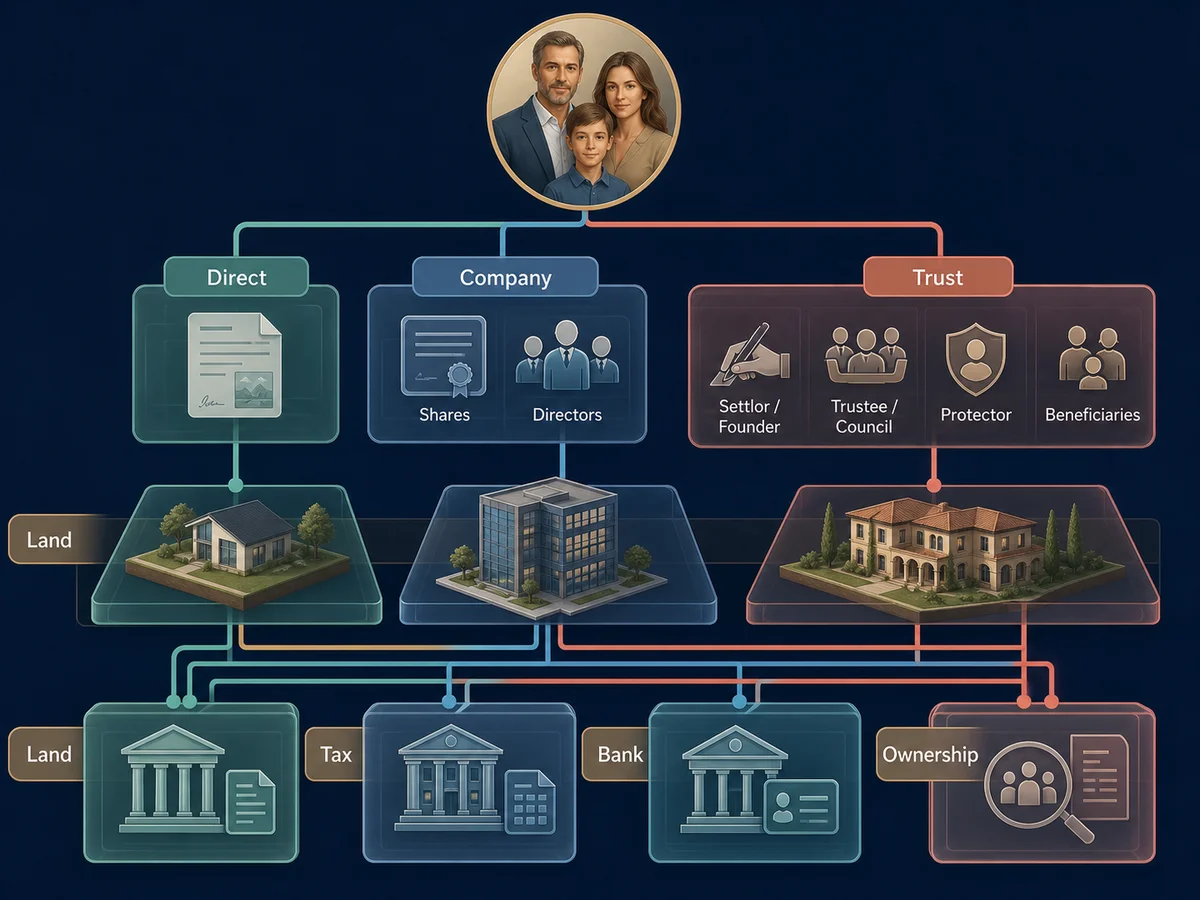
Nor does a trust or foundation hide the natural people involved. FATF standards seek adequate, accurate and current information about the individuals who ultimately own or control companies and legal arrangements. The FATF beneficial-ownership framework looks through formal title. Land registries, tax authorities, banks and regulated professionals can have overlapping information duties even when public access is limited. Public access is a separate issue covered in our beneficial-ownership registers guide.
| Issue | Personal | Company | Trust or foundation-like structure |
|---|---|---|---|
| Control | Immediate | Through shares, board and company law | Through fiduciary or charter rules; founder control may be restricted |
| Financing | Quote the individual's available mortgage products | Quote entity-specific terms and guarantee requirements | Confirm lender acceptance, trustee powers and any guarantees |
| Disclosure | Title and tax records identify the owner | Entity plus beneficial-owner records | Trustee, founder, protector, beneficiary or controller data may be reportable |
| Administration | Personal returns and property records | Accounts, returns, registers and corporate maintenance | Governing records, trustee or council decisions, tax and trust or foundation filings |
| Succession | Will, intestacy and local property process | Share succession plus director and signatory continuity | Potential continuity of title, subject to tax, validity and mandatory succession rules |
Where an overseas company owns UK land, the Register of Overseas Entities makes the point concrete: the entity generally registers its beneficial owners and obtains an Overseas Entity ID. Companies House guidance describes the registration duty, and its enforcement policy explains the consequences of noncompliance. Entity ownership changes the disclosure channel; it does not make ownership invisible.
Price the structure through rent, succession and sale
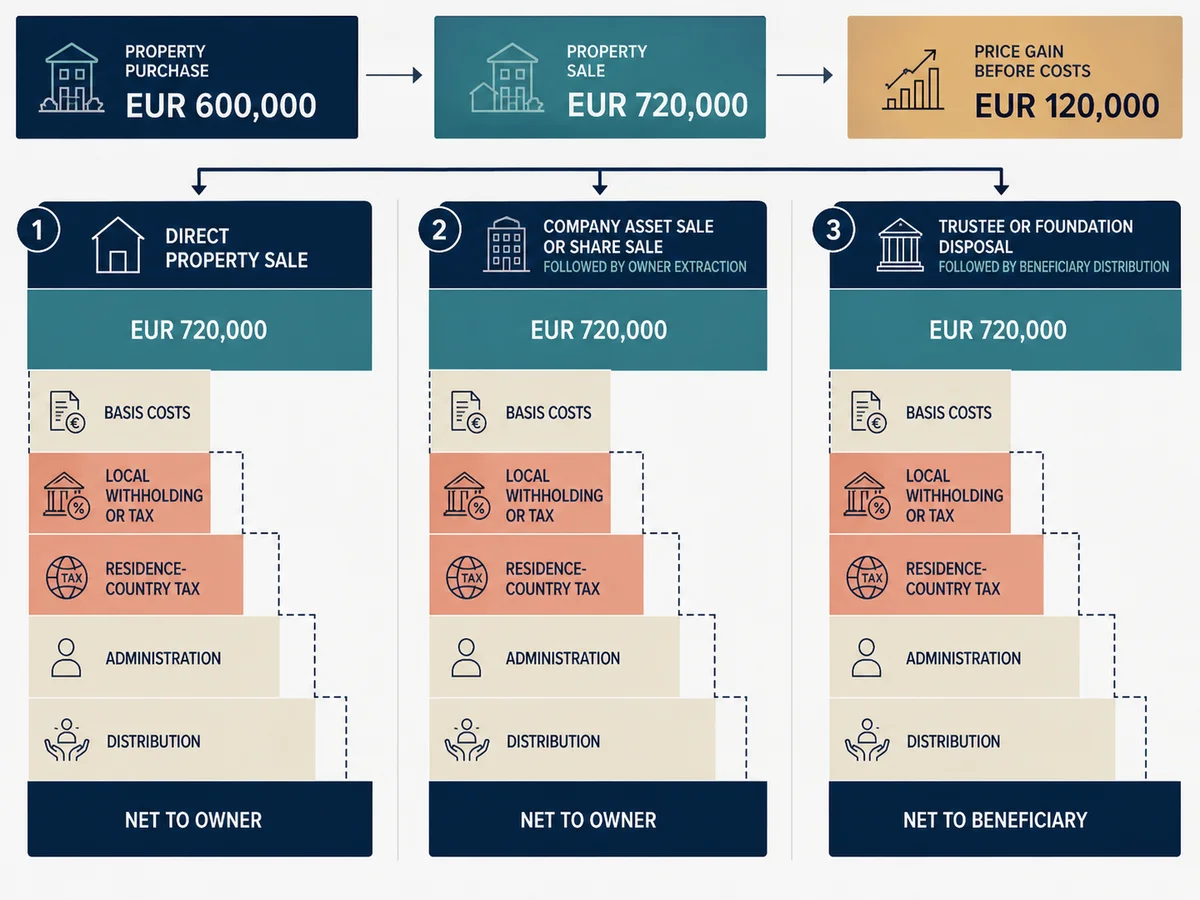
Consider an investor buying a EUR 600,000 apartment abroad. Assume annual gross rent of EUR 30,000, non-financing property costs of EUR 8,000 and interest of EUR 12,000. Before tax and principal repayments, the property produces EUR 10,000. After five years it sells for EUR 720,000, giving a simple EUR 120,000 price gain before purchase costs, improvements and sale expenses.
| Question | Personal purchase | Company purchase | Trustee or foundation purchase |
|---|---|---|---|
| Who reports EUR 10,000? | The individual, subject to property-country and residence-country rules | The company; later extraction by the shareholder is tested separately | The liable taxpayer depends on the arrangement and the residence of trustees, vehicle and beneficiaries |
| What happens on death? | The apartment enters the applicable succession process | The company keeps title, but shares and management authority must pass | Title can continue under the governing arrangement, without guaranteeing inheritance-tax exemption |
| How is EUR 120,000 tested? | Direct property gain | Property sale inside the company or a possible share sale, plus extraction | Disposal by the trustee or vehicle, followed by any beneficiary distribution |
| What must be priced? | Personal tax, probate and local representation | Corporate tax, distribution tax, accounts and wind-up or sale costs | Trustee or council fees, reporting, tax at each relevant person and distribution mechanics |
The example cannot identify a winner without country rules and personal facts. It does reveal the right model. Calculate acquisition cash, five years of after-tax rental cash, annual administration, death or incapacity consequences, and net sale proceeds. Use the same financing assumptions. Then stress-test personal use, a change of residence and a buyer who refuses to acquire company shares.
For a real exit, replace EUR 120,000 with a tax basis that includes only permitted acquisition and improvement costs. Add withholding and clearance procedures. Canada's section 116 process for non-resident dispositions shows how certificates and purchaser withholding can affect completion cash before final tax is settled.
Succession planning also needs its own legal memo. Under EU cross-border rules, the law of the deceased's last habitual residence generally governs succession, with a possible choice of nationality law, but national inheritance taxes are outside that EU rule. The EU's cross-border inheritance guidance recommends planning the applicable law. A company or trust may improve continuity while leaving tax and mandatory-heir questions open. Compare the tax layer separately in our inheritance and estate tax guide.
Legal and tax caveat: This guide provides general information checked through July 23, 2026. Property, company, trust, succession and beneficial-ownership rules change and may classify the same structure differently. Obtain coordinated advice in the property country and every country of residence before signing or transferring title.
Frequently Asked Questions
Is it better to buy overseas property personally or through a company?
Personal ownership is usually the first structure to price because it has fewer legal and filing layers. A company can be justified by commercial letting, several investors, liability separation or retained reinvestment. Compare acquisition charges, annual tax, distribution tax, compliance and both asset and share exits before deciding.
Does a company protect an overseas property from inheritance tax?
Not automatically. The property remains in the company, but the shares enter the shareholder's succession and tax analysis. Some countries also look through entities, tax property-rich shares or apply situs rules. Coordinate the share plan, company management and local succession documents.
Can a trust avoid probate on foreign property?
A valid trust may provide continuity because the trustee remains the legal owner when a settlor or beneficiary dies. Local land law, recognition of the trust, forced-heirship rules and tax can still require action. Probate avoidance is a legal outcome to confirm, not a universal trust benefit.
Can entity ownership keep the beneficial owner private?
Do not plan on secrecy. Public access varies, but companies, trusts, banks, tax authorities, land registries and regulated professionals can require beneficial-owner information. The relevant question is who can access which record, not whether the natural controller disappears.
What should be completed before making an offer?
Obtain ownership and foreign-buyer eligibility advice, lender terms for each structure, acquisition and annual tax estimates, a succession plan, disclosure and compliance costs, and net proceeds for each exit route. Put any required entity, deed or shareholder agreement in place before title is committed.
Sources Used in This Guide
- HMRC, tax implications of the Register of Overseas Entities
- Companies House, register an overseas entity and its beneficial owners
- HMRC, Annual Tax on Enveloped Dwellings
- HMRC, Stamp Duty Land Tax for corporate bodies
- HMRC, SDLT rates for non-UK residents
- HMRC, register a trust
- HMRC, trusts and Capital Gains Tax
- UK government, owning land and property with someone else
- HMRC, non-resident trusts
- HMRC, non-resident indirect disposals
- Companies House, Register of Overseas Entities enforcement
- Australian Taxation Office, CGT discount
- Australian Taxation Office, trust capital gains and losses
- Australian Taxation Office, transferring property to family or friends
- Canada Revenue Agency, non-resident dispositions under section 116
- Canada Revenue Agency, Non-Residents and Income Tax
- IRS, foreign trust reporting requirements and tax consequences
- IRS, FIRPTA withholding
- FATF, beneficial ownership
- Your Europe, planning a cross-border inheritance
Related Articles
- Non-Resident Property Owners: Rental and Capital Gains Tax by Country. Use this after choosing a structure to compare country-level property taxes.
- Beneficial Ownership Registers by Country. Compare reporting with public-access rules without assuming secrecy.
- Offshore Trust vs Foundation: Which and Where. Examine the legal and governance differences between the two family-holding forms.
- Inheritance and Estate Tax by Country. Add country-specific succession tax to the ownership decision.
- How Double Tax Treaties Actually Work. Understand relief when two countries tax the same rental income or gain.